|
|
 |
|
|
|
|
Humans are arguably the most critical element in the safety, reliability, and performance of complex systems. Our highly adaptive problem-solving capabilities create resilient operations across aerospace applications, especially with the advent of increasingly intelligent software and hardware systems. Advances in machine learning, adaptive automation, advanced display technologies, and information accessibility create new challenges for human performance and new opportunities for human-automation teaming.
In aeronautics, humans are the backbone of a national aviation system that must handle growing consumer demands. In space, long-duration exploration missions will require revolutionary changes in the roles of the astronauts and mission controllers to support autonomous operations. For both aeronautics and space, the design of hardware and software systems must address the need for safe, efficient and cost-effective operations, both in-flight and on the ground.
The Human Systems Integration Division is creating and applying a new understanding of how individuals and teams assimilate and act on information in pursuit of goals critical to the success of NASA missions.
|
|
The Human Systems Integration Division enables the development of complex aerospace systems through analysis and modeling of human performance and human-automation interactions.
|
|
|
|
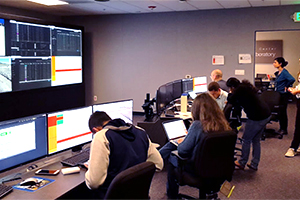
To enhance aviation safety and performance for manned and unmanned aerial systems by designing human-centered automation, decision support tools, evaluation techniques, and organizational practices.
Image caption- Human Systems Integration Division researchers conducting Unmanned Airspace System (UAS) Traffic Mangement (UTM) research. |
|
|
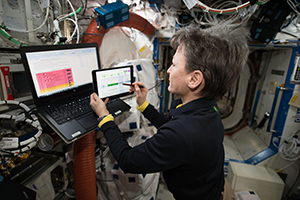
To enable functional human-autonomy teaming through the design and development of increasingly intelligent systems and augmentative technologies.
Image caption- Astronaut Peggy Whitson in the International Space Station (ISS). |
 |
|
To enable lunar and deep space exploration missions by advancing our knowledge of human performance in the challenging space environments and developing technologies for effective, safe, increasingly autonomous astronaut operations.
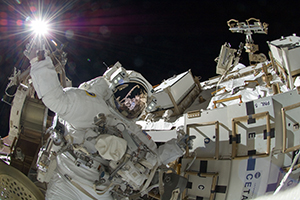
Image caption- Astronaut in an Extravehicular Activity (EVA) suit outside the International Space Station (ISS). |
|
|
|